
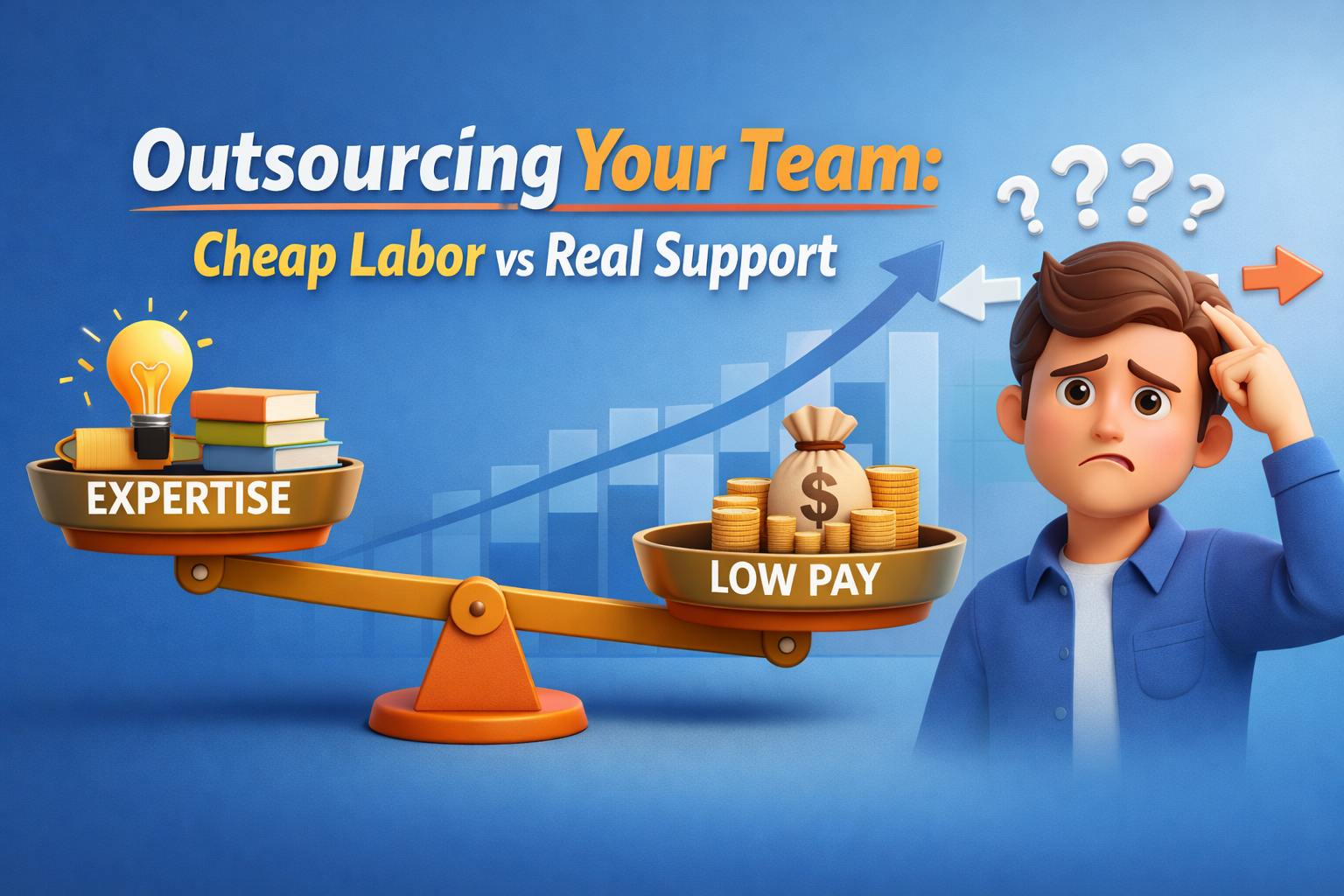
Outsourcing has become one of the most popular ways for online businesses to grow. Founders hire virtual assistants, operations managers, designers, marketers, and support staff from countries like the Philippines, Pakistan, India, Kenya, Nigeria, and other parts of Africa and Asia.
In theory, this is a win-win.
Founders get support.
Skilled professionals get global opportunities.
But in practice, outsourcing often goes wrong. Not because remote teams do not work, but because many founders approach international hiring with the wrong mindset.
Let’s talk about it.
There is a growing trend of founders actively looking for the cheapest labour possible. Rates as low as $3 to $5 per hour are common in job posts, even when the expectations are extremely high.
The thinking usually goes something like this:
“If I’m hiring from a developing country, it should be cheap.”
That mindset is not only outdated, it is damaging.
Countries like the Philippines and many African nations are full of highly skilled professionals. People who have degrees, certifications, years of experience, and real expertise in what they do. The fact that someone lives in a different economy does not automatically make their work less valuable.
When founders equate location with low worth, they miss out on incredible talent and create unhealthy working relationships from the start.
Here is the part many founders do not realize. Low pay almost always leads to low morale. And low morale leads to lower quality work.
When someone is underpaid, a few things tend to happen:
• They do the bare minimum required
• They avoid taking initiative
• They do not feel invested in the business
• They are constantly looking for better opportunities
• Turnover becomes high
This is not because they are lazy or unprofessional. It is because they are human.
You cannot expect exceptional thinking, proactive problem solving, and long-term loyalty from someone who is struggling to make ends meet.
And when quality drops, founders often blame the team instead of the system they created.
Another major issue is role confusion.
Many founders hire remote team members to perform task-based work. That is completely fine. Not every role needs to be strategic.
But problems arise when founders start expecting employee-level commitment, strategic thinking, and business growth ideas from people they are paying task-based rates.
A freelancer or virtual assistant working at a low hourly rate is usually juggling multiple clients. That is the trade-off. You get flexibility and lower cost, but not full mental ownership of your business.
If you want someone to think deeply about your operations, improve systems, manage people, and actively help grow the company, you are no longer hiring task support. You are hiring expertise. And expertise costs more.
From an operations and OBM perspective, underpaying a team creates serious downstream problems.
As an operations manager, you are expected to lead, motivate, and optimize performance. But when the team is underpaid and overworked, you are managing frustration instead of productivity.
This leads to:
• Constant performance issues
• Low accountability
• Passive resistance
• Burnout
• Poor communication
• A lack of ownership
No amount of project management tools or SOPs can fix a team that feels undervalued.
Operations do not exist in a vacuum. Systems are run by people. And people perform better when they feel respected and fairly compensated.
One comment that comes up often is:
“If I’m going to pay that much, I might as well hire someone from the US or Europe.”
This comparison misses the point entirely.
You are not paying for geography. You are paying for skills, output, reliability, and impact.
There are international professionals who outperform their Western counterparts in speed, adaptability, and execution. The difference is not ability. The difference is opportunity and exposure.
Dismissing global talent because of location is one of the fastest ways to limit your business growth.
This is the question founders need to answer honestly.
If your goal is to save money, then hire task-based support with clear boundaries. Be realistic about what you expect. Do not demand strategic input, emotional labor, or business ownership.
If your goal is to build a sustainable business, then invest in your team. This includes your international team.
Pay fairly.
Define roles clearly.
Reward initiative.
Create growth paths.
There is a middle ground. You can hire internationally and still pay well relative to skill level. But you must adjust your expectations accordingly.
Many founders see team pay as an expense. In reality, it is one of the strongest operational investments you can make.
Well-paid teams:
• Perform better
• Stay longer
• Take ownership
• Reduce turnover costs
• Improve client experience
• Reduce founder burnout
Strong operations are built on trust, clarity, and fairness. Not on squeezing the most work out of the lowest rate.
Outsourcing is not the problem.
International hiring is not the problem.
Remote teams are not the problem.
The problem is hiring purely for cost and expecting excellence in return.
Founders need to decide what they are truly hiring for. Tasks or expertise. Short-term savings or long-term stability.
When you respect and invest in your team, including your global team, the results show up everywhere. In your operations. In your culture. In your growth.
And most importantly, in the kind of business you are proud to run.